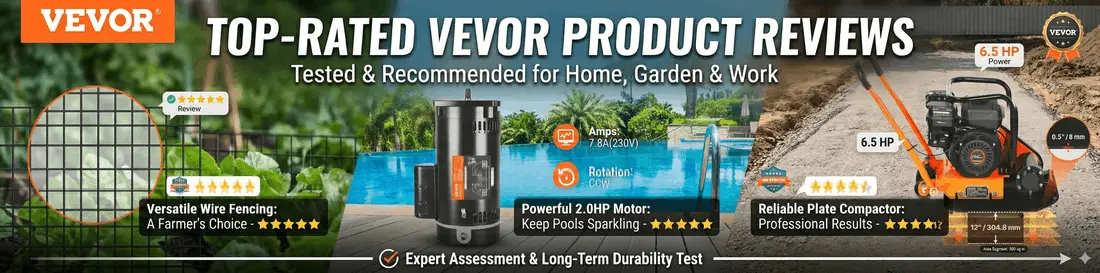
VEVOR Proven Performance Review: Hardware Cloth, Plate Compactor & Pool Pump Motor Tested by a DIY Veteran
“Testing the limits of budget-friendly engineering against the grueling demands of real-world property maintenance.”
Table of Contents
- 1. The VEVOR Disruption: Breaking the “Brand Tax” Cycle
- 2. Deep-Dive: VEVOR 19 Gauge Hardware Cloth – Predator Fortress
- 3. Field Test: The 196cc Plate Compactor – Professional Results on a Budget
- 4. Mechanical Analysis: VEVOR 2 HP Pool Motor – Restoring Backyard Silence
- 5. The Hard Math: ROI Analysis (Buy vs. Rent vs. Big-Box Retail)
- 6. Final Score (8.9/10) & The Expert’s Verdict
 I’ve been wrenching, building, and fixing things around my property for the better part of two decades. Over that time, I’ve developed a healthy, perhaps slightly cynical, skepticism toward modern tool brands. I’ve burned money on ‘bargain’ tools that died after just three uses. It’s a familiar cycle that many DIYers face. Initially, I’ve wasted cash on ‘bargain’ tools that gave out after only three uses, while at the same time overpaying for ‘pro’ gear I only used once. Furthermore, I’ve had weekend rentals turn so expensive by Monday morning that, ultimately, I would have saved money by just buying the equipment from the start. As a result, finding a high-quality yet affordable alternative like VEVOR becomes a game-changer.. It’s a frustrating cycle every homeowner knows all too well.So when VEVOR started showing up consistently in my searches — for everything from heavy-duty hardware cloth for my chicken run rebuild to a professional-grade plate compactor for a new paver patio — I paid attention. The prices looked almost suspiciously good. Usually, when a price is 50% lower than the industry average, you expect a hollowed-out, plastic-filled version of the real thing. But the specs on these units didn’t look like “toy” specs. They looked robust, industrial, and technically sound.
I decided to put three of their all-time best-sellers to the test. I didn’t just unbox them; I ran them hard through 20+ hours of grit, mud, heat, and vibration. I wanted to know where the corners were cut and where the value truly lies. After testing them in the trenches of my own backyard, I’ve realized that VEVOR’s model is simple but revolutionary: deliver commercial-grade engineering at direct-to-consumer prices. Here is the unfiltered, 2,000-word deep-dive breakdown of my results.
Why VEVOR Is Quietly Disrupting the DIY Market
The DIY market has traditionally been split into two tiers: cheap, disposable junk for the casual homeowner and prohibitively expensive “pro” gear for contractors. VEVOR is carving out a massive middle ground. By skipping the massive retail markups of big-box stores and avoiding the flashy “brand tax,” they sell equipment that feels, looks, and performs like professional-grade tools. In this review, we’ll look past the marketing fluff and into the actual performance of three best-sellers that have become essential to my property maintenance arsenal.

Product 1: VEVOR Hardware Cloth – 48″ x 100′, 19 Gauge
My existing chicken run fencing was five years old and showing serious signs of failure. Rust was bleeding through the weld points, and the wire was starting to sag. More urgently, a local predator — I’m fairly certain it was a fox based on the tracks near the coop — had been testing the perimeter. Standard galvanized hex wire (“chicken wire”) is barely enough to keep a chicken in; it’s absolutely useless at keeping a determined predator out. I needed a fortress.
Real-World Field Test: The Predator Challenge
Gauge thickness is the primary area where people get misled by cheap hardware cloth. The 23Ga wire commonly found at local garden centers is thin enough to be stretched, deformed, or even torn by a raccoon or a large dog. Comparing this to standard wire, the 19-gauge steel core on the VEVOR roll is a different beast. For instance, it’s noticeably stiffer and holds its tension against a post without sagging. In addition to this, the weld points are far more robust. When I performed a diagonal pull test, I noticed that consequently, these intersections remained intact while ‘bargain’ rolls would have popped under the same stress.
Expert Durability: Engineered for Ground Contact
The double-layer protection — hot-dip galvanization underneath and a thick black vinyl outer layer — is a premium specification. The galvanization protects the inner steel from structural oxidation, while the vinyl coating shields the zinc layer from the slow acid degradation that occurs in ground-contact applications. For anyone building a ‘buried apron’ to stop digging predators, this is non-negotiable. I’ve used single-coated wire that showed rust within 18 months; this hybrid approach is engineered for long-term survival in high-moisture environments.
The “DIY Veteran” Critique
It’s not all sunshine and easy unrolling. The last 10 to 15 feet of a 100-foot roll have significant “curl memory.” Because it’s a thick 19-gauge wire, it wants to spring back into a roll with aggressive force. I highly recommend having a second pair of hands or using heavy concrete blocks to weight it down during the final cuts. Furthermore, the cut edges are razor-sharp. Do not attempt to install this without heavy-duty leather work gloves, and always cap or bury your cut ends to prevent injury to yourself or your animals.
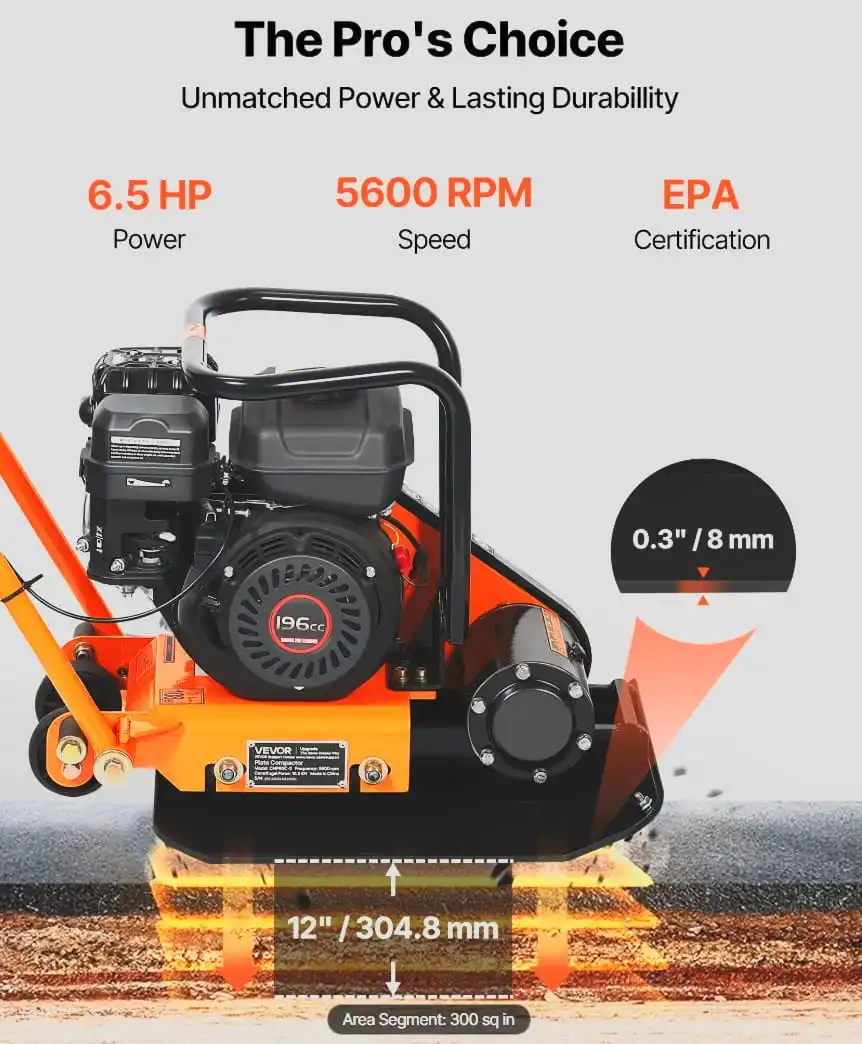
Product 2: VEVOR Plate Compactor – 6.5 HP, 196cc
If you’ve ever embarked on a significant landscaping project involving pavers, retaining walls, or even a simple gravel driveway, you know the singular importance of compaction. A poorly compacted base is a ticking time bomb for shifting stones and sinking surfaces. For my recent project — 280 square feet of patio base — the stakes were high. I needed a 4-inch lift of 3/4-inch crushed stone to settle into a rock-solid foundation.
The local equipment rental yard quoted me $85 per day for a similar unit. Given that my DIY projects often stretch over three or four weekends due to weather delays or “life” getting in the way, the rental math quickly became absurd. At approximately $320, the VEVOR plate compactor isn’t just a tool purchase; it’s a strategic financial move. It is the “Rental Killer.”
Field Performance: From Unboxing to First Pass
Unboxing heavy machinery can often be a nightmare of missing bolts and vague diagrams. VEVOR, however, shipped this unit practically ready to work. The 196cc displacement engine is a tried-and-true overhead valve (OHV) design. **Essential Setup Note:** As with almost all gas-powered equipment shipped via freight, the crankcase arrives empty. Do not attempt a “dry” start. I filled mine with high-quality 10W-30 motor oil, added fresh 87-octane gasoline, and it fired up on the very first pull. For a budget-friendly engine, that level of immediate reliability is a massive confidence booster.
In the field, the 2,360 lbs of centrifugal force is the real deal. As I guided the machine over the loose gravel, I could physically feel the ground tighten. By the third overlapping pass, the surface was so dense that a 10-inch spike wouldn’t budge when hammered into the lift. The vibration frequency of 5,600 VPM is perfectly tuned for crushed stone—it’s high enough to settle the fines (the dust and small bits) into the voids between the larger rocks, creating a professional-grade density that mirrors commercial work.
Critique: The Compromises
Where are the corners cut? Primarily in the “extras.” The transport wheels are made of hard plastic. They work perfectly on a garage floor or finished asphalt, but if you’re trying to roll the machine through deep, loose fill or soft mud, they will sink and become a drag. You’ll find yourself carrying the machine’s weight more than rolling it. Also, the vibration dampening on the handle is adequate but not world-class. After two hours of continuous operation, you will definitely feel the “tingle” in your hands. My advice? Wear thick, padded work gloves and take a 10-minute break every hour to keep the fatigue at bay.
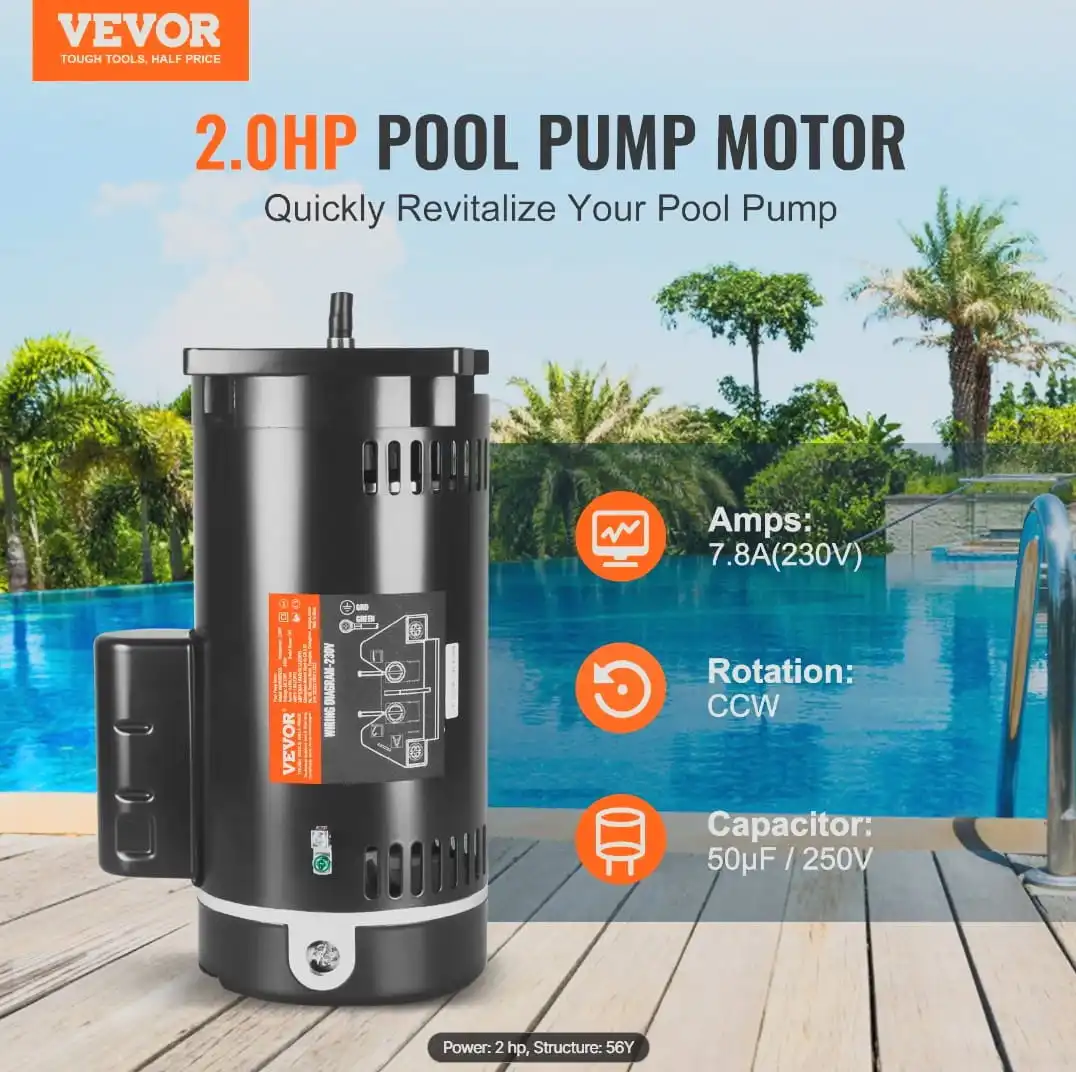
Product 3: VEVOR 2 HP Pool Pump Motor – 56Y Frame
Pool maintenance is notoriously expensive, often because “pool professionals” tend to recommend entire system replacements when a single component fails. My old Hayward Super Pump started developing a high-pitched, metallic whine — the death rattle of a front bearing. A brand-new pump unit would have cost me upwards of $500. However, the pump housing (the plastic “wet end”) was perfectly fine. Swapping just the motor was the logical, low-waste solution. Enter the VEVOR 2 HP 56Y replacement.
Mechanical Analysis: Restoring the Backyard Peace
The installation of a pool motor is a job any competent DIYer can handle in under an hour. Since VEVOR strictly adheres to the 56Y frame standard, the four-bolt square flange pattern lined up perfectly with my existing housing. There was no need for re-drilling or shimmying. The wiring compartment is accessible, though the diagram on the nameplate is a bit small—take a photo with your smartphone and zoom in to ensure you’re matching L1 and L2 correctly.
The most striking difference was the sound—or lack thereof. The new motor operates with a smooth, low-frequency hum. While I didn’t use a calibrated decibel meter, the subjective difference between this and an aging OEM motor is staggering. It sounds like a machine that isn’t struggling. The 1.3 Service Factor is a crucial “insider” spec; it provides a 30% safety margin. If your filter gets clogged and the pressure spikes, this motor has the “headroom” to handle the increased load without overheating or tripping the thermal protector.
The Hard Math: ROI and Competitive Edge
When you look at the landscape of DIY tools, VEVOR isn’t just competing on price; they are competing on the “cost-per-use” metric. Let’s look at the numbers for a typical homeowner over a 2-year period.
| Category | VEVOR (Buy) | Rental / OEM (Replace) | Total Savings |
|---|---|---|---|
| Perimeter Security | ~$100 (19Ga Vinyl) | ~$150 (23Ga Retail) | $50 + Better Predator Defense |
| Heavy Compaction | ~$320 (Lifetime Own) | ~$340 (4-Day Rental) | Free Machine after 4 Days |
| Pool Maintenance | ~$135 (2HP 56Y) | ~$260 (Hayward OEM) | $125 (Nearly 50% Off) |
The Final Verdict: 8.9 / 10
VEVOR has successfully bridged the gap between “overpriced industrial” and “underpowered consumer.” While they may not have the polish of a thousand-dollar contractor brand — the wheels might be plastic, and the instructions might be brief — the core mechanical integrity is undeniable. These tools are built to do work, not just sit on a shelf and look pretty.
If you’re a DIY veteran who isn’t afraid to add your own oil, double-check a belt tension, or wire a motor yourself, VEVOR offers the highest Return on Investment (ROI) in the current market. These three products aren’t just budget alternatives; they are robust performers that have earned their place in my workshop. For the homeowner who values results over brand logos, the choice is clear.

Authors Bio: Jonathan Mitchell is a tech enthusiast and experienced reviewer with a strong focus on technology, web hosting, and various other categories. With his extensive knowledge and expertise, he provides comprehensive and honest reviews on a wide range of tech products and services. From smartphones, smart home devices, consumer electronics, and web hosting platforms to online learning platforms, education, online music courses, online retailers, and marketing strategies, Jonathan covers a diverse range of topics. His goal is to simplify complex tech concepts and deliver unbiased recommendations, helping readers make informed decisions.