Augusta Precious Metals is built for one kind of customer: someone with at least $50,000 to put into gold or silver who wants to understand the deal before signing it. For that buyer, Augusta does something most gold IRA dealers won’t. It talks openly about the gap between what you pay for metal and what it would pay to buy it back, and it puts a target number on that gap.
Augusta has served customers since 2012 from offices in Beverly Hills, California, and Casper, Wyoming. It sells mainly gold and silver, for IRAs and for cash buyers, and it markets awards such as Money’s “Best Overall Gold IRA Company” and Investopedia’s “Most Transparent” label, according to its own site.
If you have less than $50,000, this isn’t your company, and we’ll point you elsewhere further down. If you have more, Augusta is the most transparent of the big phone-based gold IRA sellers we’ve reviewed, with a nearly empty complaint file to match.
Risk note: precious metals pay no interest, can fall in price, and lose value to spreads and storage fees. This is general information, not financial or tax advice. Talk to a licensed advisor before you move retirement savings.
The 5% spread target, explained
Every dealer sells metal above what it would pay you for the same coin on the same day. That spread is the real cost of a gold IRA, and it usually dwarfs the yearly fees. FINRA’s investor bulletin on buying physical metals notes that some fraudulent dealers have charged spreads above 300%, while legitimate dealers may charge under 20%.
Augusta’s pricing and resale FAQ says it targets a purchase-to-buyback spread of about 5% for qualifying transactions. Its own example: if your metal’s retail price is $50,000 on the day of a qualifying sale, a 5% spread means a $47,500 bid.
Read the fine print, because it matters:
- The target applies to “qualifying structured transactions,” such as partial IRA sales, required minimum distributions, and non-IRA partial sales of metal held at least five years.
- It does not automatically apply if you liquidate the whole IRA at once.
- It’s a target, not a guaranteed future bid.
Augusta also says it reviews the purchase price and the same-day buyback price with you before you confirm an order. Ask for both numbers in writing. If they’re about 5% apart on bullion, you’re getting a fair deal by industry standards.
What an Augusta IRA costs each year
The account fees are paid to the independent custodian and depository, not to Augusta. Fees checked October 24, 2026.
| Fee | Amount |
|---|---|
| Minimum purchase (IRA or cash) | $50,000 |
| Account setup (once) | $50 |
| Custodian (yearly) | $125 |
| Storage and insurance (yearly) | $110 |
| First-year total | $285 |
| Each year after | $235 |
On $50,000, $235 a year is under 0.5%. Augusta adds no yearly management fee, and its IRA FAQ says it may pay custodian and storage fees for qualifying accounts, potentially for up to ten years. Ask whether your account qualifies and get the terms in writing.
A worked example on $100,000
Say you put $100,000 into bullion and gold goes nowhere for ten years. Account fees come to $2,400 ($285 in year one, then $235 for nine more years), assuming Augusta doesn’t cover them. At a 5% spread, selling back part of the metal costs about $5,000 more. That’s roughly $7,400, or 7.4% of your money, just to break even. At a 20% spread, the same decade costs $22,400. The spread, not the fee table, is the number to negotiate.
Augusta doesn’t post coin prices online. Its reason is that a price alone, without the matching buyback bid, can make a weak deal look cheap. That’s a fair argument, and it’s also why you need both numbers on paper before you pay.
The education-first sales process
Augusta’s pitch is that it teaches before it sells. In practice that means:
- One-on-one sessions explaining how gold and silver IRAs work, before any purchase
- Educators who are salaried and, Augusta says, don’t earn product-specific sales commissions
- A team that handles roughly 95% of the paperwork with your old plan and the new custodian
- Lifetime account support for valuations, RMDs, transfers and sales
Augusta also tells customers to steer clear of “free silver” promotions, which it says it has never seen improve a buyer’s overall economics. We agree. A bonus is usually paid for by a higher premium on everything else.
Two smaller protections are worth knowing about. Some purchases qualify for a seven-day money-back window, and a “Highest Buyback Price Guarantee” gives you 24 hours after a recorded buyback call to cancel if another dealer offers more for the same metal.
Storage rules and what you can’t do
Your IRA metal goes to an approved depository, and it has to stay there while it’s in the IRA. Augusta says this plainly in its FAQ: home storage of IRA metal can cause a taxable distribution and penalties. Metal bought with personal funds can be shipped to you with insured delivery.
Required minimum distributions still apply to a traditional gold IRA. You can usually meet them by selling part of the metal or by taking coins out in kind. Augusta helps with partial sales, and your custodian calculates the required amount.
What owners complain about
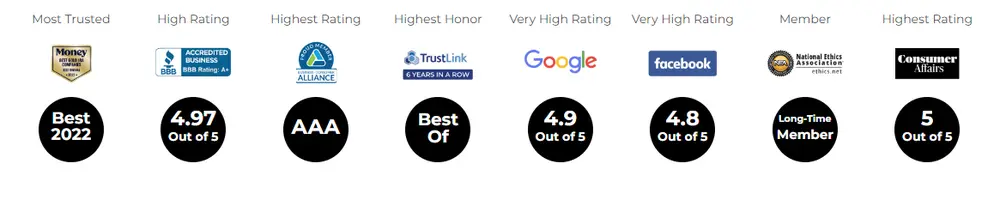
Not much, publicly. Augusta has been BBB-accredited since 2015, holds an A+ rating, and, according to its BBB profile, had a single complaint in the past three years at the time we checked. Its Trustpilot score sits around 4.8.
That one complaint deserves a fair hearing because it’s about the thing that matters most. Filed in January 2026, it alleges the customer paid far above typical market prices for gold and silver bought with retirement funds, and disputes the buyback pricing. BBB lists it as “answered,” meaning Augusta responded but the customer didn’t accept the outcome. It’s one allegation, unproven, but it shows why the 5% target only helps if you confirm it applies to the products you’re buying.
Among the rare negative Trustpilot reviews, a few say the person setting up their account seemed to rush through it, and they chose not to go ahead. The other limit isn’t a complaint so much as a wall: the $50,000 minimum is a business choice, and it shuts out most savers.
Augusta vs Noble Gold, Birch Gold and BullionVault
| Augusta | Noble Gold | Birch Gold | BullionVault | |
|---|---|---|---|---|
| Minimum | $50,000 | $20,000 IRA | $5,000 | None |
| Yearly fees | $235 after year one | $285 | About $235 | 0.12% gold storage |
| Buyback spread disclosed | ~5% target, qualifying sales | No | No | Live prices on screen |
| Best for | Larger, careful buyers | First-timers | Smaller accounts | Low-cost vaulted ownership |
If your budget is smaller, Noble Gold starts IRAs at $20,000 and Birch Gold at $5,000. If you don’t need an IRA dealer at all, BullionVault lets you buy vaulted bars at near-spot prices. Our precious metals reviews compare them in more depth.
Who should skip Augusta
Skip it if you have under $50,000, if you want to see prices online without a phone call, or if you plan to cash out the whole account at once, since the 5% spread target doesn’t cover a full liquidation. The full pros and cons list is below.
Our verdict on Augusta Precious Metals
Augusta is the premium choice among phone-based gold IRA companies, and the premium buys something real: a stated buyback spread target, no commissions on its educators, possible fee coverage for years, and one of the cleanest complaint records in the industry. The $50,000 minimum keeps most people out. If you clear it, buy common bullion, confirm the spread on your exact products in writing, and Augusta is our top pick for a gold IRA.
See the rest of our money reviews or read our review method for how we weigh published terms against complaint records.