
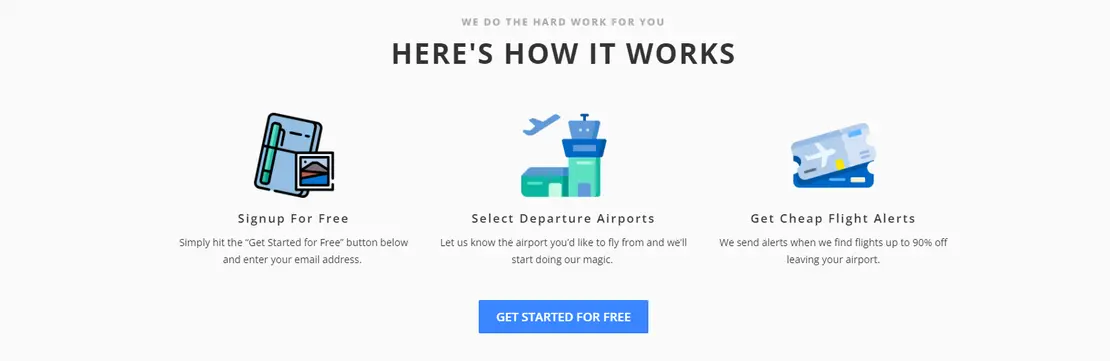
Dollar Flight Club works on a simple bet: you’d rather get an email saying “New York to London, $283 round trip” than spend your evenings refreshing fare searches. Pick your home airports, list a few dream destinations, and DFC’s team sends alerts when fares drop well below normal. You book directly with the airline or travel site. DFC never sells you a ticket.
For travelers with flexible dates, it’s one of the cheapest ways to stumble into a trip you’d otherwise never have priced. The annual fee is modest and one good international fare covers it many times over. The two things to watch are whether your airport gets enough deals, and the auto-renewal rules, which are strict.

DFC plans and prices compared
From Dollar Flight Club’s plans page, checked October 24, 2026:
| Plan | Price | Deals | Airports | Extras |
|---|---|---|---|---|
| Basic | Free | 1 to 3 a week, domestic economy | 1 | Daily newsletter |
| Premium | $69 a year | Up to daily, domestic and international | 4 | 10 dream destinations, mistake fares |
| Premium+ | $99 a year | Everything in Premium | 4 | Business class, SMS alerts, partner perks, member-only deals, priority support |
Both paid plans can be tried for $1, and DFC advertises discounted access for active military, veterans and travelers over 60. It also says members can earn up to 5% back when booking flights through DFC.
The jump from Basic to Premium is the meaningful one: international deals, mistake fares and three more departure airports. Premium+ makes sense mainly if you’d actually book business class on a deal or want text alerts so you don’t miss short-lived fares.
The kind of deals that show up
DFC’s homepage showed these recent examples on the day we checked, with the “typical” price DFC compares them against:
| Route | Deal fare | DFC’s typical fare |
|---|---|---|
| Denver to New York | $59 | $350 |
| Houston to Cancun | $161 | $550 |
| San Francisco to Hawaii | $181 | $675 |
| New York to London | $283 | $730 |
| Atlanta to Paris | $380 | $840 |
| Los Angeles to Tokyo | $499 | $1,100 |
Treat these as illustrations rather than promises. DFC says most deals are for travel months ahead, not last-minute trips, and the best fares tend to come with limited travel windows. Big hubs like New York, Los Angeles and Chicago see far more deals than smaller regional airports, which is why listing more than one departure airport matters.
How to get your money’s worth
- Add every airport you’d realistically drive to. Premium allows four, and a two-hour drive to a hub often beats a connection.
- Pick dream destinations you’d go to on short notice of a sale, rather than bucket-list places you’ll never book.
- Book fast, then verify. Many great fares disappear within hours. If you book directly with a US airline at least seven days before departure, the Department of Transportation’s 24-hour rule means the airline must let you cancel within 24 hours for a full refund or hold the fare. That gives you a day to sort out time off.
- Book with the airline when you can. DOT says the 24-hour requirement doesn’t cover tickets bought through travel agents or online travel agencies, so refunds there depend on the agency.
Renewals and refunds: read this before the trial
DFC’s refund policy is blunt, and it’s the source of most negative reviews:
- Paid memberships renew automatically every year. You cancel in the member dashboard.
- Automatic renewals are non-refundable, and there are no prorated refunds if you stop traveling mid-year.
- If your $1 trial converts to a paid plan, that charge isn’t refundable either.
- Memberships bought with a coupon or during a sale renew at full price.
- Lifetime memberships, when offered, are one-time and non-refundable.
None of that is unusual for subscription software, but people forget about $1 trials. Put a reminder in your calendar the day you sign up, and check your renewal date in the dashboard.
What owners complain about
The positive reviews tell the same story again and again: a fare to Europe or Asia for a fraction of the usual price, booked because an email landed at the right time. Many members say the first deal paid for years of membership.
The complaints cluster around a few points:
- Charges after a trial from members who say they canceled or didn’t realize it would convert. DFC’s position is that terms are shown at signup and in the dashboard.
- No refunds on renewals, even when the account went unused.
- Thin deal flow from smaller airports, which makes Premium feel like poor value for some members.
- Deals that are gone by the time you click, especially popular routes.
If you live near a major hub and set a cancellation reminder, most of these problems don’t apply to you.
Dollar Flight Club vs Going, Google Flights and KAYAK
Going (formerly Scott’s Cheap Flights) is the best-known rival, with a free tier, Premium at about $49 a year and Elite at $199 a year for premium-cabin deals. Going is cheaper for economy alerts, while DFC’s Premium+ is far cheaper than Going Elite if you want business-class deals.
Google Flights and KAYAK price alerts are free and good for tracking a specific route and dates. They won’t surprise you with a destination you weren’t watching. Our KAYAK review covers its alerts and price forecasts in detail.
Once a deal lands, you’ll need things to do at the other end. Our GetYourGuide review covers booking tours and attractions, and our travel reviews and deals page collect more ways to save. For other memberships that pay for themselves, browse our lifestyle section.
Who should skip Dollar Flight Club
Skip it if your dates and destinations are fixed, if you live far from a major airport, or if you’re the type to forget a trial. The pros and cons below sum up the rest.
Our verdict on Dollar Flight Club
Dollar Flight Club is a smart, low-cost way for flexible travelers to find fares they’d never see otherwise. Start on the free plan to see how many deals your airport gets, step up to Premium when you’re ready for international fares, and set a renewal reminder. For most people who travel at least once a year, it earns its fee.
Our review method explains how we research services from published plans, policies and customer feedback.